If you want students to actually grow — not just get coached through test tricks — spiral review is essential. But here’s the truth:
Most spiral review is just random practice.
A few questions here, a worksheet there, a center thrown in because it “sort of helps.”
That’s not spiral review.
Real spiral review is data-driven, intentional, and targeted at misconceptions — not just repeated exposure.
Let’s break down how to do it the right way.
Step 1: Start with Two Data Points — Not Just One
Pull:
-
Your most recent assessment
AND -
Your benchmark or end-of-year assessment (if you have it)
Why?
You’re not just looking for what kids missed this week.
You’re looking for the skills they are still missing — the ones that will cost them later.
That’s the difference between:
Reviewing what’s fresh
vs.
Intervening where it matters
Step 2: Identify the Bottom 3 Standards (Not Just the Lowest Scores)
Let’s be clear:
You don’t spiral review every weakness.
You target the 3 standards that are showing up as consistently weak.
This is where tools help.
I use EdCite through Clever — my district pays for it — and it’s a game changer because it highlights the most missed standards instantly.
If you don’t have that, you can still:
-
Sort your test data by standard
-
Circle the bottom 3
-
Then compare them to your end-of-year or benchmark data
The ones that overlap?
Those are your priority standards.
And this is why:
You want growth — not panic-teaching every gap you find.
Step 3: Diagnose the Misconceptions — Not Just the Errors
This is the heart of everything.
You are not reteaching:
-
The whole unit
-
The entire TEKS
-
All 20 skills inside a standard
You're reteaching:
The thing that broke their thinking.
That means asking:
-
What were they trying to do here?
-
Did they misunderstand the vocabulary?
-
Were they solving the right problem the wrong way?
-
Did they confuse this skill with another one?
Example:
If kids missed comparing fractions because they lined up numerators…
The issue isn’t "fractions."
It’s how to compare numbers that look different but represent value.
If you can name the misconception clearly,
you can fix it quickly.
If you can’t?
You’re about to waste a lesson.
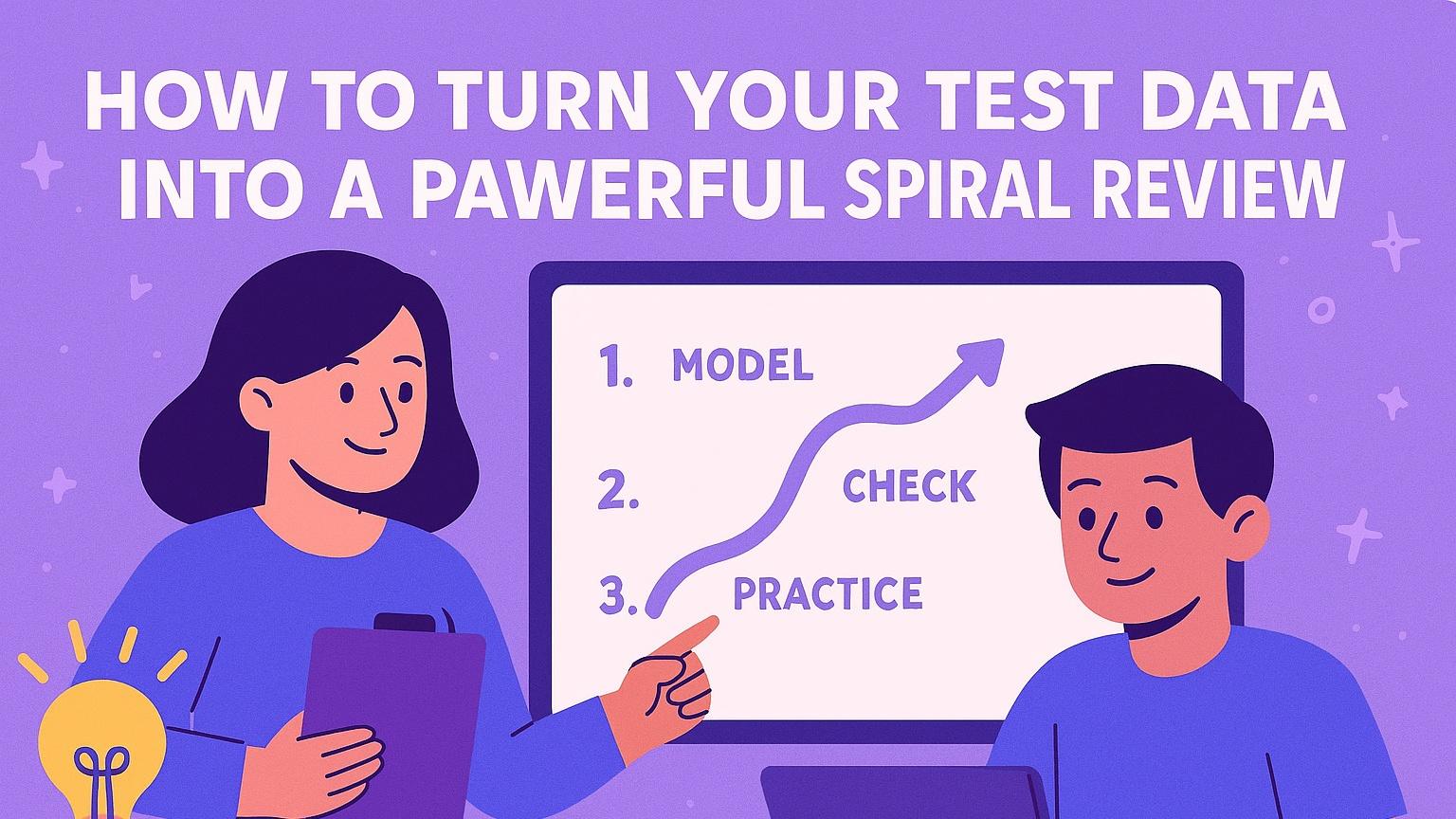
Step 4: Turn Each Weak Standard into a 3–4 Day Spiral Cycle
Here’s the simple rhythm that works (and actually sticks):
Day 1 – Mini Lesson + Model
Short, focused reteach — not the whole standard
Day 2 – Check for Understanding
5–8 questions
Small group time if needed
Quick grading — not a test
Day 3 – Spiral Integration
Add it to:
-
warm-ups
-
exit tickets
-
stations
-
partner practice
-
homework
Optional Day 4 – Apply It
Real-world example
STAAR-style item
Short written explanation
This cycle prevents overload — and builds mastery over time.
Step 5: Make Spiral Review a Daily Routine Instead of a Surprise
You don’t need theme weeks.
Or packets.
Or a 17-page binder.
Just 2–4 mixed questions a day, on rotation.
If that sounds overwhelming to write — that’s because it is.
Which is where EasyClass AI steps in.
How EasyClass AI Makes Spiral Review 10X Faster
Most teachers waste hours writing:
-
reteach lessons
-
warm-ups
-
practice sets
-
exit tickets
-
and slide decks
EasyClass AI can generate all of that, using your exact standard — in seconds.
Here’s how you can use it during this process:
When You Identify the Weak Standard
Use Lesson Plan Generator
-
Type in the standard
-
Add the misconception you're targeting
-
Choose grade level
-
Done
You get:
-
Objectives
-
Teaching steps
-
Differentiation suggestions
-
Guided & independent practice
When You Need Practice Questions
Use Worksheet Generator
You can even choose:
-
multiple choice
-
open-ended
-
short answer
-
real-world
-
story problems
And here’s the best part:
Once it's generated — you can edit it.
So if your kids need easier or harder questions?
Click, revise, done.
When You Need a Quick Exit Ticket
Use Exit Ticket Generator
It will build:
-
2–3 targeted questions
-
Aligned to your standard
-
Perfect for checking mastery
Great for warm-ups too.
When You Want to Teach It with Slides
Use Presentation Generator
You literally type:
-
Grade 4
-
TEKS 4.4H
-
Misconception: Students think larger denominators mean larger values
And it builds:
-
An intro slide
-
Examples
-
Guided practice questions
-
A wrap-up
All in the style you choose:
Clean, bold, colorful, etc.
The Secret to Making Data-Driven Spiral Review Work
It’s not:
-
A fancy tool
-
A data meeting
-
Or a new planner
It’s this:
Fix the thinking — not just the answers.
And do it on purpose — not randomly.
When you combine that mindset with a tool that saves your time, things change:
✔ You stop guessing
✔ Spiral review becomes easy to sustain
✔ Students don't just redo work — they understand it
✔ You spend less time prepping, more time teaching
And most importantly —
they actually master the skills.
Not because you drilled them.
Because you targeted the root problem, and you kept circling back — strategically.
That’s real spiral review.
And it works.