December is chaos.
Your students are full of peppermint sugar, classroom parties, and “when is break??” energy.
Meanwhile, you’re staring at pacing guides, semester exams, and a stack of state standards.
You want engagement, not a free-for-all.
You want to acknowledge the season, without turning your room into the North Pole or burning a week on crafts that have nothing to do with learning.
Here’s the real answer:
anchor everything in the standard, then layer festive elements on top like seasoning—not the entire meal.
1. Start With Standards, Then Wrap the Theme Around It
Most teachers do this backwards:
🎄 Pick a holiday activity → scramble to justify standards later.
That’s how you end up with:
-
gingerbread posters that teach nothing
-
“write a letter to Santa” instead of opinion writing
-
holiday trivia disguised as social studies
Do it the opposite way:
Standard → Skill → Holiday wrapper
Example:
-
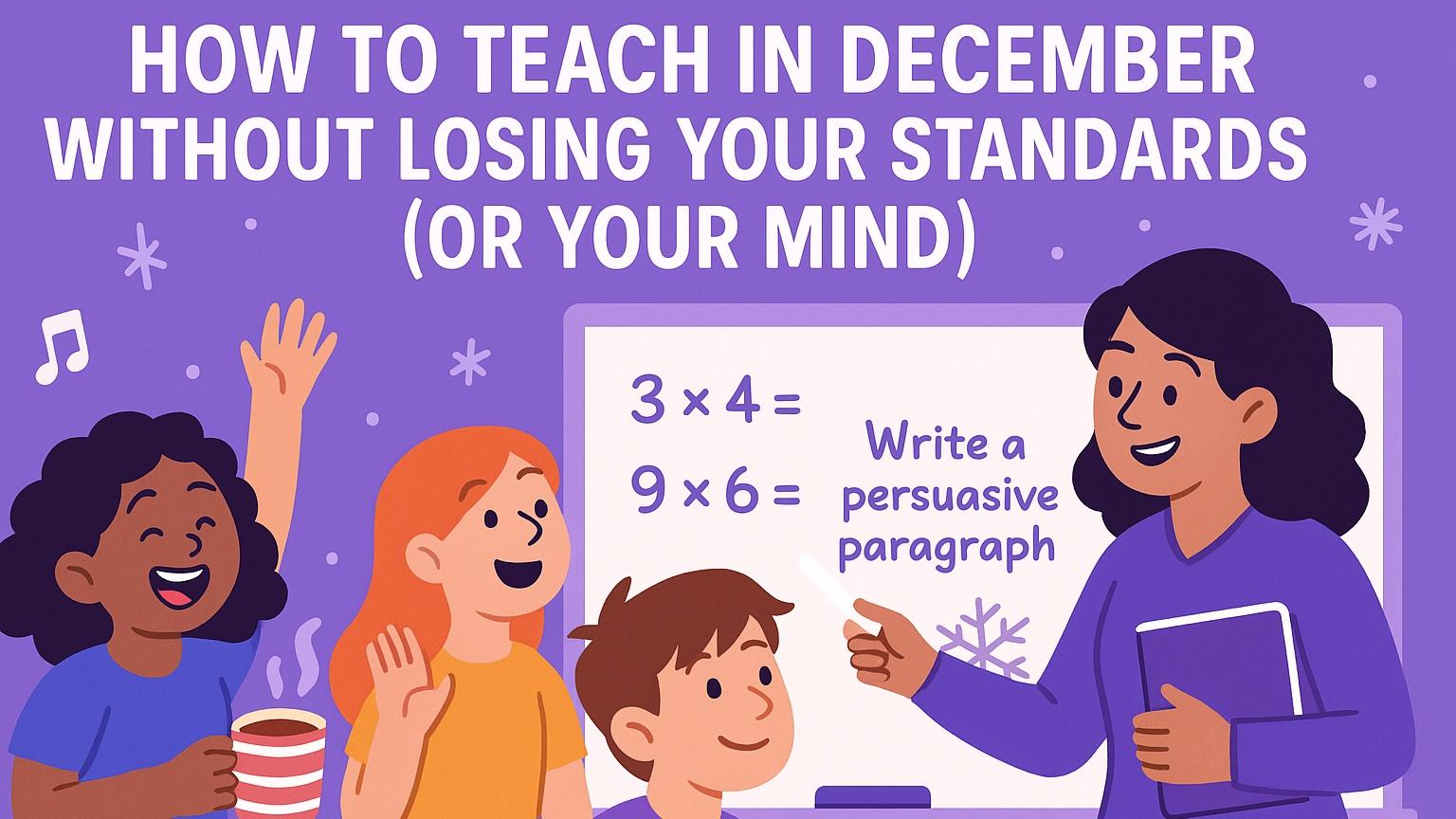
Standard: Students write persuasive texts with supporting reasons.
-
Task: Write a persuasive paragraph.
-
Holiday wrapper:
“Convince your family why your winter break activity plan is the best.”
Holiday theme = context.
Standard = spine.
EasyClass AI Shortcut:
Use Assignment Creator:
Create a persuasive writing assignment aligned to 4th grade standards. Use a winter theme. Provide sentence stems and a rubric.
You get:
-
real standards language
-
actual skill development
-
scaffolds you don’t have time to build
2. Choose Holiday-Neutral Winter Themes
Let’s be blunt: school is not the place for religion wars, parent emails, or “why can’t we talk about Christmas?”
Stick with:
-
Winter
-
Snow
-
Cozy classroom vibes
-
Gingerbread as a building challenge, not Santa
-
Cocoa / mittens / books
-
Travel / traditions / family time
Avoid:
-
Santa
-
Nativity
-
Elf on the Shelf
-
Angels
-
“Jesus is the reason”
-
Anything that forces belief
You can honor culture without forcing participation.
3. Replace Decorations With Academic Tasks
Instead of:
❌ Holiday craft afternoon
❌ “decorate the room” day
❌ ornament making
Use:
🎯 Academic “holiday stations”
-
Holiday-themed math word problems
-
Poetry about a winter moment
-
Snowflake geometry challenges
-
Map analysis of winter climates
-
Holiday traditions around the world (cultural, not religious)
Kids feel festive.
You stay aligned to standards.
Example Holiday-Neutral Math Station (Grades 3–6)
The Hot Cocoa Stand
Each cocoa mug is $3.25
Marshmallows cost $0.25 each
You have $10.00
“How many mugs can you buy with 3 marshmallows each?”
It’s multiplication & division of decimals in December clothing.
EasyClass AI Shortcut:
Worksheet Generator prompt:
Generate 6 holiday-neutral winter math problems for 5th grade using decimals and money. Include answer key.
Print → run → teach.
4. Use Holiday Context to Build Better Writing
Kids don’t magically write better because it’s December.
They write better when they care about the prompt.
Here are writing prompts that hit standards without reading like “Dear Santa:”
Narrative
“Tell the story of the best snow day ever.
What went wrong and how did you fix it?”
Procedural
“Explain step-by-step how to make a cup of hot chocolate someone has never tried.”
Informational
“Describe how your family celebrates anything in December. You may choose a food, a habit, or a tradition. It doesn’t have to be a holiday.”
Opinion
“Which winter activity is superior: movies at home or outdoor adventure? Support your reasons.”
Every one of these is standards-aligned.
Not wishlists.
EasyClass AI Shortcut:
Use the Warm-Up Generator:
Generate 6 winter writing prompts that align to narrative, opinion, and informational standards for 4th grade. Avoid references to specific holidays.
You instantly have a week of bell ringers that aren’t chaos.
5. Turn Holiday Chaos Into Real Data
Students are energetic in December.
So weaponize it.
Example:
Snowflake Sorting (ELA or Math)
ELA:
Sort vocabulary words into:
-
“winter context”
-
“general context”
-
“academic context”
Math:
Sort winter-themed word problems by:
-
one-step
-
multi-step
-
missing information
-
too much information
It’s a disguised assessment of skills, not “let’s color snowflakes.”
EasyClass AI Shortcut:
Generate a 3-tier sorting activity where students categorize winter-themed problems into one-step, multi-step, and misleading. Include 2 problems per category.
Boom.
6. Use Seasonal Content to Teach Culture (Not Religion)
December is a cultural gold mine:
-
Winter solstice
-
Hanukkah traditions
-
Kwanzaa principles
-
New Year celebrations
-
Lunar traditions in Asia
-
Holiday food around the world
You are not saying “believe this.”
You are saying “this is how humans celebrate.”
Ask:
-
Why do people gather?
-
What values are shared?
-
What traditions exist across cultures?
It’s standards-aligned social studies with universal respect.
7. Make Projects Mini, Not Epic
Pinterest teachers create:
-
cardboard villages
-
gingerbread house engineering builds that take six class periods
-
ornament factories
December should not destroy your pacing.
Use:
-
1–2 class periods max
-
Clear rubric
-
Skill-based output
Make students show thinking, not glue sticks.
Example: Holiday Market Economics (5th–8th)
Students create:
-
one product
-
price point
-
cost of labor/materials
-
2 marketing arguments
They run a fictional market.
They learn opportunity cost, demand, and competition.
8. Never Trade Standards for “Fun”
If you feel guilty after teaching it, it wasn’t instruction.
Here’s the litmus test:
Could I defend this lesson to my admin as standards mastery?
If the answer is “Uhhh…” → it’s Pinterest cosplay.
Kids can have fun and master the objective.
That’s your job.
9. EasyClass AI Makes This Simple
December is survival month.
Standards do not disappear, and your energy is dwindling.
Use AI to do the heavy lifting:
-
Worksheet Generator → Holiday-neutral math & ELA centers
-
Warm-Up Generator → Winter writing prompts, vocabulary context tasks
-
Assignment Creator (AI Tools) → Cultural projects, persuasive tasks
-
Quiz Generator → Holiday-themed review that still hits the standard
You don’t need 3 hours of prep.
You need structure and direction.
Let students have fun within boundaries.
Let EasyClass handle the output.