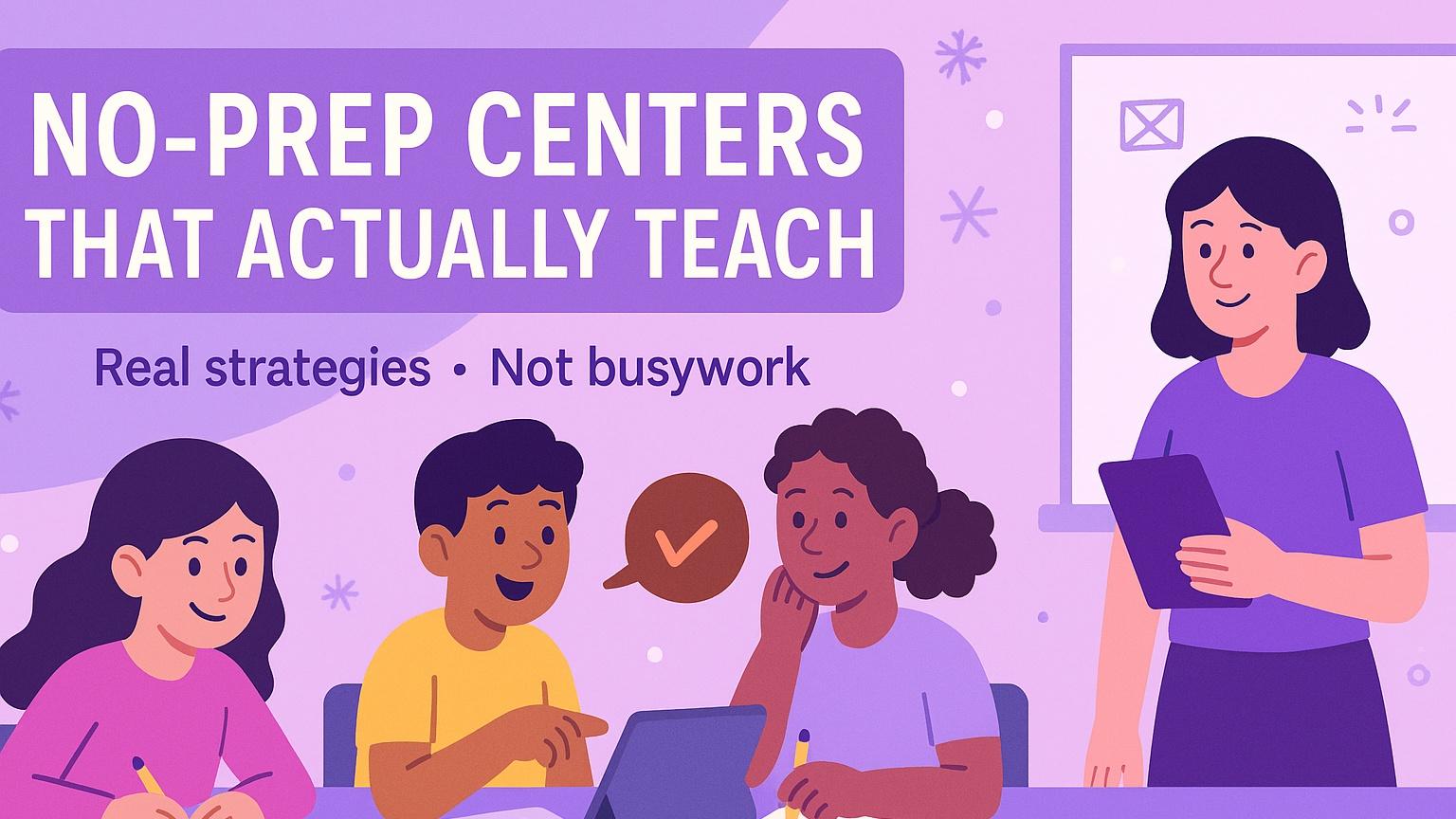
Centers can be a classroom superpower… or a total disaster.
The difference isn’t the activity.
It’s the thinking you require.
When centers work, students move independently, think deeply, and practice real skills while you circulate strategically.
When they flop, they turn into busywork: coloring, copying definitions, quiet chaos disguised as “learning.”
December is the perfect time to reset them—especially if you’re reviewing for exams, calming behavior, or getting your classroom back into instructional routines without burning yourself alive.
Below are no-prep centers that actually teach, plus how to use EasyClass AI to build them in minutes (not Sunday night at 10PM).
Table of Contents
-
What Makes a Center “Academic”
-
Center 1: Fix the Mistakes
-
Center 2: Vocabulary in Context
-
Center 3: Student-Tutor Table (with scripts)
-
Center 4: Silent Spiral Review
-
Center 5: Short Output Tasks
-
Mini Center Schedules You Can Copy
-
Grade-Band Examples (K–2, 3–5, Middle School)
-
What Not to Do
-
Why These Centers Work (The Learning Science)
-
EasyClass AI: Tools That Power Real Learning
What Makes a Center “Academic”
Centers are not about keeping kids busy.
They are about moving the cognitive load off you and onto them.
Academic centers force students to:
-
retrieve information
-
fix mistakes
-
explain their reasoning
-
apply vocabulary in context
-
model concepts visually
-
teach peers
If a center does not require thinking, it is not instructional.
It’s babysitting.
Center 1: Fix the Mistake (10–15 minutes)
Give students incorrect examples—not a sheet of matched practice problems.
Students must:
-
Find the mistake
-
Correct it
-
Explain why it’s wrong
-
Explain how to avoid the mistake in the future
This works in every subject:
-
math operations
-
grammar
-
science diagrams
-
paragraph structure
-
timeline errors
-
lab procedures
It forces analysis instead of copying.
Copy-Paste Prompt for EasyClass AI (Worksheet Generator)
Generate 6 problems with intentional student mistakes for 5th grade multiplying decimals. Include a space where students explain the error and how to fix it.
Center 2: Vocabulary in Context (No Definitions Allowed)
Students who can “define” a word but not use it in reality don’t understand it.
Context is the teacher.
Tasks you can use immediately:
-
Use each term in a real example
-
Provide a “yes” example and a “no” example
-
Connect two vocabulary words in one sentence
Do not accept:
“Condensation is when water…”
That’s memorization.
You want application.
Copy-Paste Prompt for EasyClass AI (Warm-Up Generator)
Create 5 vocabulary-in-context prompts for 6th grade science using conduction, convection, and radiation. Require real examples. Avoid definitions.
Center 3: Student-Tutor Table (Scripted, Not Freelance)
You already know your students who “get it.”
Use them—with structure.
How it runs:
-
1 student coach
-
2–3 students who need support
-
a script of prompts
Coaches are not allowed to:
-
give answers
-
lecture
-
redo the work for peers
Their job is to pull thinking out of others.
Sample coach prompts:
-
“Show me how you solved it.”
-
“Where do you think the mistake happened?”
-
“Tell me what step confused you.”
This builds academic language, confidence, and metacognition.
Copy-Paste Prompt for EasyClass AI (Assignment Creator)
Create a peer tutoring center for 5th grade fraction operations. Include coaching prompts, student expectations, and reflection questions.
Center 4: Silent Spiral Review (Independent, 10–12 minutes)
This center is where you see the truth.
Rules:
-
No whispering
-
No phones
-
No “guess and hope”
-
Quiet thinking
Give 5–7 mixed review questions.
One slide or one page.
Keep it simple.
Students show what they know, not what they begged you to reteach.
Copy-Paste Prompt for EasyClass AI (Quiz Generator)
Generate 10 spiral review questions for 7th grade math. Include integer operations, solving one-step equations, and unit rates. Include answer key.
Duplicate → regenerate → differentiate.
That is how you scale centers instead of rewriting them every week.
Center 5: Short Output Tasks (Not Projects)
NO posters.
NO cereal box restorations.
NO tri-fold performance art.
A short output task proves learning in 10–12 minutes.
Examples:
-
Write 3 steps to solve the problem
-
Draw a labeled diagram
-
Create a short flow chart
-
Show 2 causes and 1 consequence
-
Model a process with arrows
If a student cannot explain their output in one sentence, they didn’t learn it.
Copy-Paste Prompt for EasyClass AI (Worksheet Generator)
Generate 4 quick output tasks for 6th grade thermal energy transfer. Include sentence frames students can complete.
Mini Center Schedules You Can Copy Today
⭐ 30-Minute Centers (Grades 3–6)
-
Station A — Fix the Mistake (10 min)
-
Station B — Vocabulary in Context (10 min)
-
Station C — Silent Spiral (10 min)
Teacher role: circulate during Station C and quietly diagnose.
⭐ 40-Minute Centers (Grades 6–8)
-
Station A — Silent Spiral (12 min)
-
Station B — Student-Tutor (12 min)
-
Station C — Output Task (12 min)
-
Transition + Reflection (4 min)
Students move independently.
You target 3–4 students per rotation.
Grade-Band Examples
K–2
-
Draw the steps
-
Use 1–2 vocabulary words in a sentence
-
Circle the mistake and fix it
-
Explain using a sentence frame (“I know because…”)
Grades 3–5
-
Error analysis
-
Write how you know
-
Explain a solution to a partner
-
Diagram a process with labels
Middle School
-
Real-world applications
-
Multi-step error correction
-
Written reasoning
-
Mini-debates on solution methods
Centers Teachers Think Are Academic (But Aren’t)
These show up on social media every December:
❌ Matching cards
❌ Word banks
❌ Coloring sheets
❌ “Find 10 nouns” scavenger hunts
❌ Quiet reading with no output
❌ Poster projects with no criteria
❌ Escape rooms with no academic checkpoints
If a student can sit brain-off and still “finish,” it is not a learning center.
Why These Centers Work (The Learning Science)
These centers unlock real retention because they leverage:
Retrieval Practice
Students pull information from memory instead of being fed the answers.
Error Analysis
Correcting mistakes builds deeper understanding faster than doing 20 perfect problems.
Peer Explanation
Teaching others forces clarity, sequencing, and metacognition.
Distributed Practice
Small exposures across time outperform one giant review packet.
This is how students grow into independent thinkers—not kids waiting for hints.
EasyClass AI: Your Prep Team Behind the Scenes
You design the thinking.
EasyClass does the paperwork.
-
Worksheet Generator (Create) → error clinics + output tasks
-
Warm-Up Generator (AI Tools) → vocabulary prompts + retrieval tasks
-
Assessment Generator (AI Tools) → spiral checks + independent review
-
Assignment Creator (AI Tools) → peer tutoring scripts + expectations
You’re not doing more work.
You’re doing the work that actually matters.
Let students think.
Let AI handle the prep.