Holistic Grading:
Fast, Big-Picture Writing Assessment
Holistic grading evaluates student writing as a unified whole rather than scoring individual criteria. Research shows holistic scoring is 3x faster than analytic methods, making it ideal for large-scale assessments, placement tests, and timed writing. The challenge? Inter-rater reliability drops to r=0.70 compared to 0.85 with analytic rubrics — but AI solves this.
Source: White (1985); Loera-Oquendo, Soliz & Lipnevich (2024)
What Is Holistic Grading?
Holistic grading assigns a single overall score based on the rater's general impression of quality. Rather than evaluating individual dimensions like thesis, evidence, and organization separately, the scorer reads the entire piece and makes one global judgment. The score is anchored to a scoring guide that describes what writing at each level looks like.
This approach differs fundamentally from analytic scoring, which breaks an assignment into 4–6 criteria and scores each independently. Holistic scoring treats the writing as greater than the sum of its parts — a philosophy rooted in the work of Edward White and the early writing assessment movement of the 1970s and 1980s.
When holistic is the RIGHT choice: timed writing assessments, placement exams, large-scale state tests (SAT, ACT, state writing assessments), and any scenario where you need to sort or rank large numbers of papers quickly. The SAT essay, AP exams, and most state writing tests use holistic scoring because it's the only practical approach for scoring millions of essays.
When it's NOT the right choice: formative feedback, revision-focused assignments, and any situation where students need to know exactly what to improve. A holistic score of “3 out of 6” tells a student they're below proficiency but doesn't tell them whether the problem is their thesis, their evidence, or their mechanics.


The 6-Point Holistic Scale
The most widely used holistic scoring guide is the 6-point scale, used by the former SAT essay, many state writing assessments, and the National Writing Project. Each level describes the overall quality of writing at that score point.
Score 6
Exceptional
Outstanding command of writing with sophisticated ideas, compelling organization, varied sentence structure, and near-flawless conventions. The response demonstrates insight and originality beyond grade-level expectations.
Score 5
Strong
Clear, focused writing with well-developed support and logical organization. Demonstrates strong control of conventions with minor errors that do not impede meaning. Ideas are thoughtful and appropriately complex.
Score 4
Competent
Adequate writing with sufficient development and generally clear organization. Demonstrates adequate control of conventions. Ideas are presented clearly but may lack depth or sophistication.
Score 3
Developing
Partially developed writing with inconsistent control of organization and conventions. Ideas may be simplistic or repetitive. Some evidence of understanding but lacks sustained focus or adequate support.
Score 2
Emerging
Limited development with significant weaknesses in organization, support, and conventions. Ideas are vague or confusing. The response may be too short to demonstrate competence or may drift off topic.
Score 1
Beginning
Minimal response with little coherence or development. May be off topic, incomprehensible, or too brief to evaluate. Demonstrates fundamental lack of writing skills at the expected level.
Holistic vs. Analytic: The Complete Comparison
The holistic-analytic debate is the central question in writing assessment. Each approach makes a fundamental trade-off. Understanding these trade-offs helps you choose the right method for each context — or use AI to eliminate the trade-off entirely.
Speed Advantage: Holistic Is 3x Faster
Holistic scoring requires one decision per essay. Analytic scoring requires 4-6 decisions (one per criterion). Research consistently shows holistic scoring is approximately 3x faster, enabling a trained scorer to evaluate 20-30 essays per hour versus 8-10 with analytic rubrics. For a state test scoring 500,000 essays, this difference translates to millions of dollars in scoring costs.
Key Insight: This speed advantage is why every large-scale writing assessment (SAT, ACT, NAEP, state tests) uses holistic scoring. The economics of analytic scoring at scale are simply impractical without AI.
Feedback Trade-Off: Holistic Gives Less Actionable Feedback
A holistic score of "4 out of 6" tells a student where they fall on the quality spectrum but not what to improve. Is the issue weak evidence? Poor organization? Mechanical errors? The student cannot tell. Analytic rubrics solve this by providing a separate score and description for each dimension, creating a diagnostic map for improvement.
Key Insight: This is the biggest argument against holistic grading for classroom use. If students cannot identify what to improve, the assessment fails as a learning tool. AI solves this by pairing a holistic score with detailed explanatory comments.
Reliability: Analytic Yields Higher Agreement
Loera-Oquendo, Soliz & Lipnevich (2024) found that analytic rubrics achieve 66% exact agreement between raters, compared to 46% for holistic scoring. The gap narrows with adjacent agreement (within one score point), but holistic scoring is inherently less reliable because raters must weigh multiple quality dimensions simultaneously in a single judgment.
Key Insight: The reliability gap exists because holistic scoring introduces "construct-irrelevant variance" — raters unconsciously weight different aspects of quality differently. One rater may prioritize organization while another prioritizes evidence, producing different scores for the same essay.
Best Practice: Match the Method to the Purpose
Use holistic for summative decisions where speed matters and diagnostic feedback is not the goal: placement tests, exit exams, timed writing, large-scale assessments. Use analytic for formative contexts where students need specific, actionable feedback: revision-focused assignments, portfolio assessments, and any assignment where the goal is student growth.
Key Insight: The best of both worlds: use AI to apply holistic scoring for your gradebook (fast, single score) while automatically generating analytic-style comments that students can use for revision. This is what EasyClass does with the calibration panel.
Research & Evidence
Holistic grading has been studied extensively since the 1970s. The research reveals both its strengths (speed, simplicity) and its limitations (reliability, diagnostic value). Every claim on this page is backed by published research.
Loera-Oquendo, Soliz & Lipnevich (2024) — Analytic vs. Holistic Reliability
Assessment in Education: Principles, Policy & Practice. The most recent comprehensive comparison of holistic and analytic scoring reliability.
Found that analytic rubrics achieve 66% exact agreement between trained raters, compared to 46% for holistic scoring. The study confirmed that analytic rubrics provide significantly more consistent scoring, though holistic scoring remains practical for large-scale assessment contexts where speed is paramount.
Holistic exact agreement
(between trained raters)
Analytic exact agreement
(for comparison)
Faster scoring speed
(holistic advantage)
White (1985) — "Teaching and Assessing Writing"
The foundational text on holistic scoring in education. White established the theoretical framework for holistic assessment, arguing that writing quality is a gestalt that cannot be fully captured by analytic decomposition. His work became the basis for the holistic scoring programs at ETS, ACT, and major state assessments.
Huot (1990) — "Reliability, Validity, and Holistic Scoring"
Demonstrated that the reliability of holistic scoring is highly context-dependent. Reliability improves significantly with calibration training, clear scoring guides, and controlled scoring conditions. Cautioned against using holistic scores for high-stakes individual decisions without adequate reliability safeguards.
Nakamura (2004) — "Holistic vs. Analytic Scoring in L2 Writing"
Compared holistic and analytic scoring methods for second-language writing assessment. Found that holistic scores correlated highly with overall language proficiency but could mask specific skill deficits. Recommended analytic rubrics for diagnostic placement and holistic rubrics for overall proficiency ranking.
Weigle (2002) — "Assessing Writing" (Cambridge University Press)
Comprehensive review of writing assessment methods. Concluded that holistic scoring is most appropriate when the purpose is ranking or sorting, while analytic scoring is preferred for feedback and instruction. Introduced the concept of "writing assessment literacy" for teachers.
Cooper & Odell (1977) — "Evaluating Writing"
One of the earliest systematic studies of holistic scoring. Established that trained raters using holistic scoring guides can achieve acceptable levels of agreement for programmatic decisions. Their work launched the widespread adoption of holistic scoring in U.S. writing programs.
Holistic Scoring Reliability Comparison
How consistent are scores when multiple raters grade the same writing holistically?
Holistic Grading Across Subjects
While holistic grading was born in writing assessment, the approach adapts to any subject where overall quality judgment matters. Here's how holistic scoring applies across content areas.
ELA / English
The natural home
- Essay exams & timed writing
- Literary analysis responses
- On-demand writing prompts
- Exit and placement exams
- AP English Language essays
6-point holistic scale
Social Studies
Document-based essays
- DBQ essays
- Research papers
- Position papers
- AP World History DBQ
- Argumentative writing on policy
Holistic scoring guide for argumentation
Science
Overall quality assessment
- Lab reports overall quality
- Scientific argumentation
- Research proposals
- Investigation summaries
- NGSS performance tasks
Holistic rubric for scientific writing
World Languages
Communication competence
- ACTFL OPI (holistic by design)
- Interpersonal communication
- Presentational writing
- Interpretive reading responses
- Cultural comparison essays
ACTFL proficiency scale (holistic)
Arts
Portfolio & performance
- Portfolio reviews
- Performance assessment
- Composition overall quality
- Creative project evaluation
- Artist statement quality
Holistic performance descriptors
AP / IB
Standardized holistic scoring
- AP English Language FRQ
- AP World History DBQ
- IB Extended Essay
- AP Seminar research paper
- IB Theory of Knowledge essay
Official AP/IB holistic guides
Holistic vs. Analytic vs. Single-Point Rubric
Each rubric type serves a different purpose. This comparison helps you choose the right approach for your assessment context. AI can bridge the gaps between all three methods.
The bottom line: Holistic grading excels at speed and is the practical choice for large-scale assessment. But it sacrifices feedback quality and reliability. AI eliminates this trade-off: you get the speed of holistic scoring with the diagnostic detail of analytic rubrics. EasyClass delivers a holistic score plus criterion-level explanatory comments, giving teachers the best of both worlds.
Common Challenges & AI Solutions
Holistic grading is fast but comes with well-documented challenges. Here are the four biggest obstacles and how EasyClass solves each one with AI.
Rater Fatigue Reduces Accuracy
The Problem
After scoring 20-30 essays, rater attention drifts. Scores become less consistent as fatigue sets in. Studies show scoring accuracy drops measurably after the first hour of holistic grading, with raters becoming either more lenient or more harsh over time.
AI Solution
AI never gets tired. It applies the same scoring standards to essay 100 as essay 1. Zero drift, zero fatigue, zero inconsistency across an entire class set or across multiple class periods scored on different days.
Scores Aren't Actionable for Revision
The Problem
A holistic score of "3 out of 6" tells students they're below proficiency but not what to fix. Is it the thesis? The evidence? The organization? Students receive a judgment without a roadmap for improvement, making revision directionless.
AI Solution
AI provides the holistic score PLUS detailed explanatory comments for each area of the writing. Students see their overall score AND specific feedback on what worked, what didn't, and exactly how to improve each dimension.
Hard to Train Raters Consistently
The Problem
Achieving inter-rater reliability with holistic scoring requires extensive calibration sessions. Each rater must internalize the scoring guide and apply it consistently. New raters take weeks to calibrate, and even experienced raters drift over time.
AI Solution
The calibration panel lets teachers set the AI's scoring threshold to match their expectations. Upload 2-3 anchor papers, adjust the scoring, and the AI calibrates to your standards. No weeks of training required.
Students Don't Understand a Single Score
The Problem
Many students find a single holistic score opaque. "Why did I get a 4?" is the most common question. Without criterion-level detail, students often attribute the score to teacher bias rather than their own writing quality.
AI Solution
AI generates narrative feedback explaining WHY the essay earned each score level. Instead of just "Score: 4," students see a paragraph explaining that their thesis was strong but their evidence was underdeveloped and their conclusion was rushed.
How to Grade Holistically with AI
From holistic rubric selection to scored essays with explanatory feedback — all in under 60 seconds.
Select a Holistic Rubric or Use the Calibration Panel
Choose from state test rubrics (SAT, ACT, STAAR) or set your own scoring scale with the calibration slider. Upload 2-3 anchor papers and the AI calibrates to match your scoring expectations perfectly.
Open Calibration PanelUpload Student Essays
Paste text, upload PDFs, or connect Google Classroom. AI evaluates each essay against your holistic criteria, reading the entire piece and assigning a single overall score based on your scoring guide.
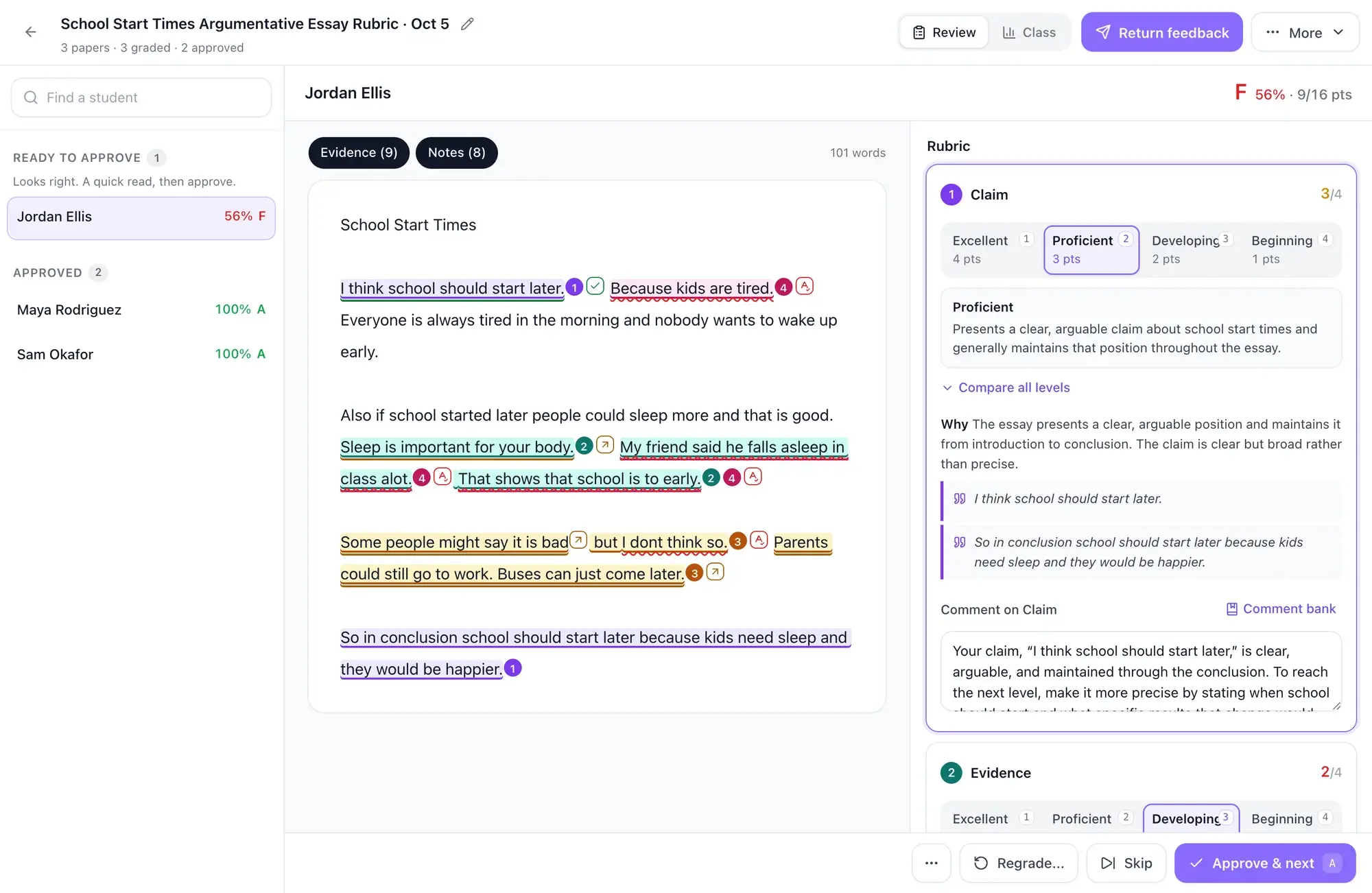
Review Holistic Scores with Explanatory Feedback
See the overall holistic score plus AI-generated narrative explaining the reasoning behind the score. Understand exactly why each essay earned its score level. Adjust with one click if needed.

Frequently Asked Questions
What is holistic grading?
Holistic grading is a scoring method that evaluates student writing as a unified whole rather than scoring individual criteria separately. The rater reads the entire piece and assigns a single overall score based on their general impression of quality, using a scoring guide that describes what work at each level looks like. It is widely used for large-scale assessments like the SAT, ACT, and state writing tests.
When should I use holistic vs. analytic grading?
Use holistic grading when speed matters most: timed writing assessments, placement exams, large-scale state tests, and summative sorting decisions. Use analytic grading when detailed feedback matters most: revision-focused assignments, formative assessments, and when students need to know exactly what to improve. Holistic is 3x faster but provides less actionable feedback for student growth.
How accurate is holistic scoring?
Holistic scoring achieves approximately 46% exact agreement between trained raters (Loera-Oquendo, Soliz & Lipnevich, 2024), compared to 66% for analytic rubrics. Adjacent agreement (within one score point) is higher, typically 85-95%. Reliability improves with calibration training and clear scoring guides. AI-assisted holistic grading eliminates rater variability entirely.
How does the 6-point holistic scale work?
The 6-point holistic scale ranges from 1 (Beginning) to 6 (Exceptional). Score 6 represents outstanding command of writing with sophisticated ideas. Score 5 is clear and focused with well-developed support. Score 4 is competent with adequate development. Score 3 is partially developed with inconsistent control. Score 2 shows limited development. Score 1 is a minimal response with little coherence. This scale is used by many state tests and the former SAT essay.
Can AI do holistic grading?
Yes. EasyClass applies holistic scoring guides with perfect consistency, evaluating each essay against the same criteria without rater fatigue or drift. Teachers can select from state test rubrics (SAT, ACT, STAAR) or set custom scoring scales using the calibration panel. The AI provides both a holistic score and detailed explanatory comments.
How does AI improve holistic grading consistency?
AI eliminates the three biggest sources of inconsistency in holistic scoring: rater fatigue (scoring drifts after 20-30 essays), the halo effect (one strong element biases the overall score), and rater disagreement (different raters apply different internal standards). AI applies the same scoring criteria to every essay with zero drift, achieving consistency that even calibrated human raters cannot match.
Grade Smarter with a Holistic Rubric — Built in Minutes with AI
The challenge with holistic rubrics is building one that's consistent, clear, and actually saves time. EasyClass's AI rubric builder generates holistic rubrics aligned to your grade level and assignment type in seconds — then lets you reuse and refine them across your whole class roster.
How EasyClass Makes Holistic Grading Faster and More Consistent
AI-generated rubrics in seconds
Describe your assignment, choose holistic format, and EasyClass builds a grade-level-appropriate rubric with clear performance descriptors for each score level. No more starting from a blank Google Doc at 10pm.
Consistent scoring across a whole class
Holistic rubrics are only useful if they're applied consistently. EasyClass anchors your rubric to each student's submission, so you're comparing to the same standard every time — not just your mood at paper 22 of 30.
Free downloadable templates + AI customization
Start with our free holistic rubric templates for writing, projects, presentations, and reading responses. Customize them with AI to match your specific assignment and standards without rebuilding from scratch.
EasyClass AI Rubric Builder vs Static Templates
Free template downloads exist — but they don't adapt to your assignment or grade your students.
| Feature | EasyClass AI Rubric Builder | Static Templates |
|---|---|---|
| Holistic rubric templates | Pre-built + AI-generated | Static download only |
| Customization | AI adapts to your assignment | Manual editing required |
| Standards alignment | Auto-aligned to grade/standards | Generic, not standards-linked |
| Reuse across classes | Saved in your dashboard | Must re-download/re-edit |
| AI grading assistance | Apply rubric to student work with AI | Grading still fully manual |
| Free to use | Free plan available | Free download |
| Holistic vs analytic toggle | Switch formats instantly | Separate static files |
Holistic Grading Rubrics — Frequently Asked Questions
What is a holistic grading rubric and how is it different from analytic?
A holistic rubric gives student work a single overall score based on total quality — the assessor reads the whole piece and matches it to a general description (e.g., "Exceeds expectations: writing is clear, organized, and engaging throughout"). An analytic rubric instead scores each criterion separately (organization, grammar, evidence, etc.) and totals them. Holistic rubrics are faster and better for portfolio or large-volume grading; analytic rubrics give more detailed feedback but take longer to apply. Most teachers use both depending on the assignment and purpose.
When should teachers use a holistic rubric instead of an analytic rubric?
Use holistic when speed matters more than detailed diagnostic feedback: large essay sets, standardized writing prompts, portfolio reviews, performance tasks where overall impression is the point, or when giving feedback during draft stages (where overall holistic impressions are more useful than criterion-by-criterion scores). Use analytic when students need to know specifically what to improve — final graded pieces, revision-based work, and complex multi-criteria projects.
Where can I find free holistic grading rubric templates?
EasyClass offers free holistic rubric templates for writing, projects, presentations, and reading responses — downloadable immediately and editable with AI to fit your specific assignment. Generate a custom holistic rubric from scratch using EasyClass's rubric builder by specifying grade level, assignment type, and the number of holistic score levels you want (typically 4: Exemplary, Proficient, Developing, Beginning). The generator writes the descriptors for each level based on your assignment.
Can AI help with holistic grading?
Yes. Once you've built your holistic rubric in EasyClass, the AI grading assistant can apply it to student work. Paste in a student response and EasyClass suggests a holistic score with a brief justification tied to your rubric descriptors — helping you grade faster and more consistently across large class sets. Teachers report saving 40-60% of grading time by using AI to generate the initial score and justification, then reviewing and adjusting rather than writing each comment from scratch.
How many score levels should a holistic rubric have?
Most holistic rubrics use 4-6 score levels. Four levels (Exemplary/Proficient/Developing/Beginning or 4/3/2/1) work well for writing because they align with common grade conversion systems and provide enough granularity to give meaningful feedback without over-complicating the holistic judgment. Six-level scales work for high-stakes assessments where finer discrimination matters. Avoid too many levels — holistic grading's speed advantage disappears when you're trying to distinguish between 8 score points.
How do I make holistic grading consistent across my class?
Three calibration strategies that work: (1) Anchor papers — before grading, select 3-4 papers that represent each score level and use them as reference benchmarks while grading the rest. (2) Blind second-score — have a colleague score 20% of the papers without knowing your scores, then compare and discuss discrepancies. (3) Rubric norming with students — share the rubric before they write so students know what each level looks like. This reduces score surprises and improves average writing quality before you even start grading.
How is holistic grading used on standardized tests like SAT, ACT, and AP exams?
Most high-stakes writing assessments use holistic scoring for practical reasons: speed and scale. AP exam essays are scored holistically on a 0-6 or 0-9 scale (depending on the test) by trained human raters using carefully normed anchor papers. The SAT essay (when it existed) used holistic scoring for Reading, Analysis, and Writing dimensions. ACT writing uses holistic scores on four domain-specific dimensions. The key to reliable holistic scoring at scale is extensive anchor-paper norming: raters view and score dozens of exemplar papers at each score point before grading live student responses. This is the same process EasyClass uses conceptually when generating its AI first-pass grades — the model is calibrated against grade-level anchor papers.